
Title: Smart Energy-Efficient Systems-on-Chip for Next-Generation Biomedical Devices
Abstract:
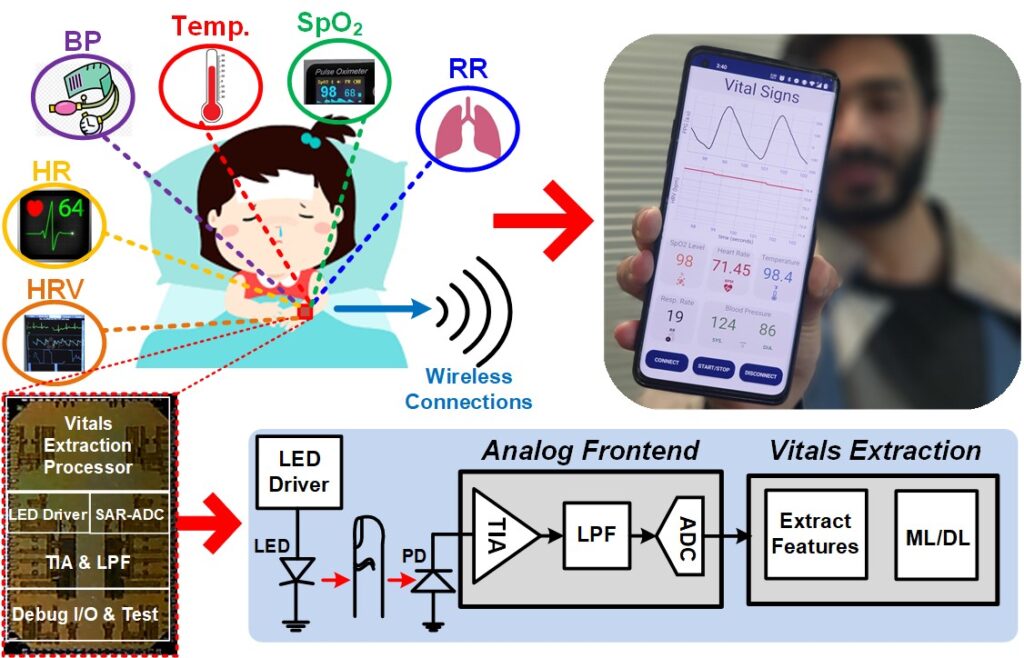
Enhancing the quality of health care and improving ease of access to health facilities while maintaining reasonable costs is challenging for healthcare organizations globally. The problem is further exacerbated by the rapidly increasing world population, and outbreaks of various infectious diseases. This has led to growing healthcare costs, shortage of caregivers, and mental stress on family members. Cumulatively, these reasons raise serious issues for society. One way of tackling these issues that are gaining attention is the establishment of self-health monitoring systems to keep track of the health status of patients. Wearable biomedical devices equipped with artificial intelligence (AI) and point of care (PoC) diagnostics technologies that enable continuous monitoring of patients’ vital signs, as well as provide rapid actionable information for patient care at the home environment. A key technological solution in these devices is low power integrated circuits that enable long battery life and small form factor.
This talk will cover the design strategies of energy-efficient System-on-Chip (SoC) biomedical devices. I will first explore the requirements, challenges, limitations, and potential pitfalls in portable/wearable interface circuit design, and strategies to overcome such issues. Moreover, I will describe my research contribution in developing several energy-efficient biomedical SoC projects. The talk will conclude with interesting future research directions and opportunities that lie ahead.

Biography:
Wala Saadeh received the B.S. degree from the Computer Engineering Department, Yarmouk University, Irbid, Jordan, in 2009, and the M.Sc. degree in Microsystems Engineering and a Ph.D. degree in Interdisciplinary Program from the Masdar Institute of Science and Technology, Abu Dhabi, United Arab Emirates, in 2012 and 2016, respectively. In 2013, she joined the Test-Chip Integration team, Global Foundries, Dresden, Germany, as a Test-Chip intern, where she performed quality assurance tests on advanced nodes for DFM. She developed a low-energy body-area-network transceiver for a binaural hearing aid for long-term continuous monitoring. From 2016 to 2022, she was with the Electrical Engineering Department, Lahore University of Management Sciences, Lahore, Pakistan, where she is currently an Assistant Professor. Currently, she is an Assistant professor in the Electrical and Computer Engineering at Western Washington University. Her current research interests include ultra-low-power wearable devices and system-on-chip design for portable biomedical devices. Dr. Saadeh is the recipient of the IEEE International Symposium on Circuits and Systems (ISCAS) 2015 Best Paper Award (BioCAS Track) and the ISCAS 2015 Runner-Up Best Student Paper Award. She is also co-recipient of the Best Paper Award (Integrated Circuit Design Track) of the 1st International Conference on Microwave, Antennas & Circuits (ICMAC 2021).